Local Powerhouse vs. Global Standard: Deconstructing the Evolving K-Pop Ecosystem with IVE and BABYMONSTER
The K-pop industry is no longer a single, linear ladder. Today, we explore how IVE and BABYMONSTER represent two powerful, yet completely different formulas for success.
1. The Two Paths to the Top of the 5th Generation
The K-pop industry is no longer a single, linear ladder where everyone climbs the exact same steps. Currently, IVE and BABYMONSTER perfectly represent two completely different, yet equally powerful, formulas for success in the evolving K-pop ecosystem.
IVE has established an absolute reign in the domestic and regional markets. With consecutive massive hits, they have secured a deeply rooted fandom and unmatched public recognition. On the other hand, BABYMONSTER, carrying the DNA of YG Entertainment, bypassed the traditional local-first approach and directly targeted the global market from day one, accumulating massive international traffic.
To understand which strategy holds the key to the future, we must look beyond the surface and deconstruct their growth trajectories using data.
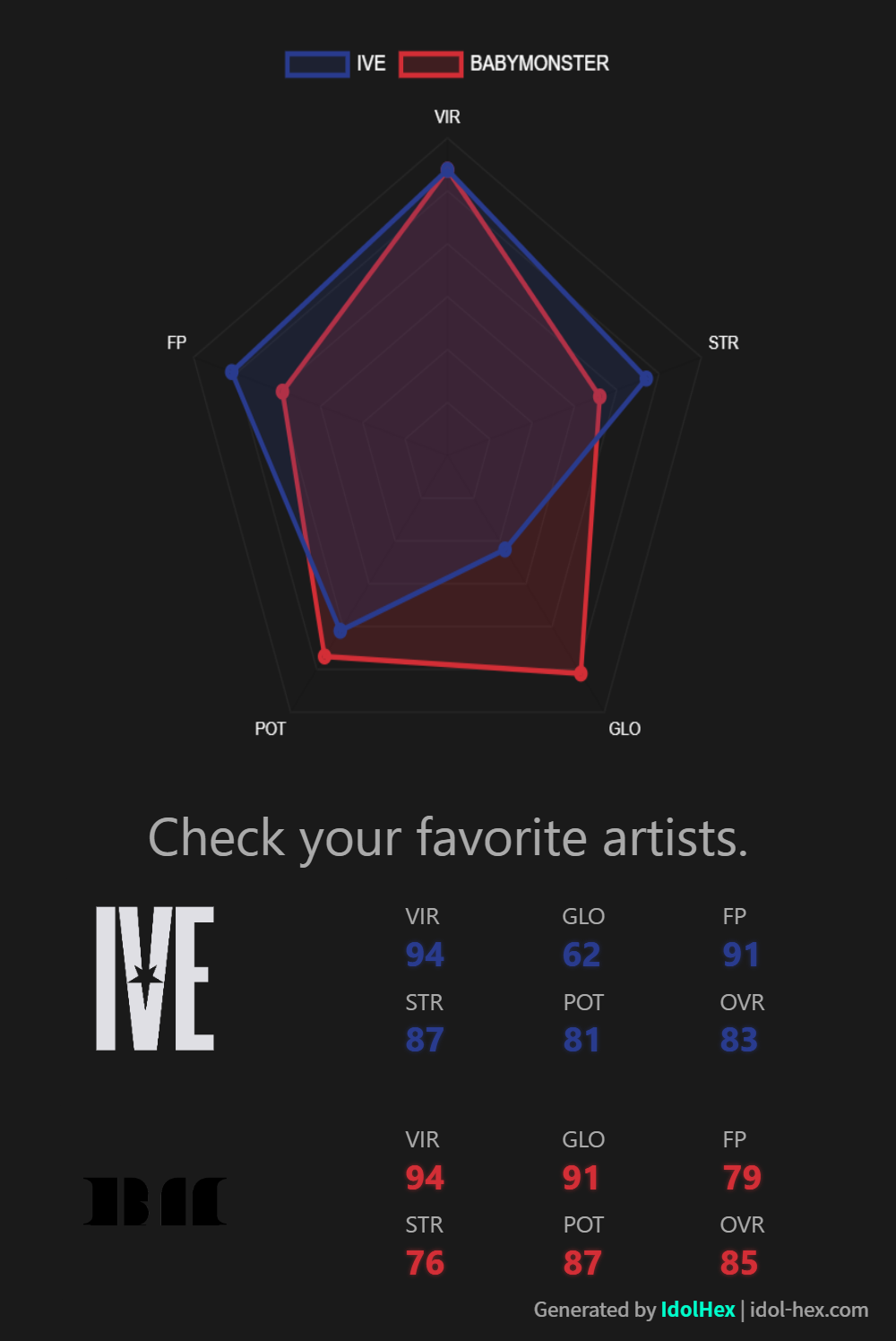
Figure 1: Comparison of GLO (Global Impact) and FP (Fandom Power) between IVE and BABYMONSTER.
2. Decoding the Diverging Strategies with IdolHex Data
When we plug these two groups into the IdolHex analysis system, the resulting radar charts look like perfectly mirrored opposites. The metrics that define their distinct identities are GLO (Global Impact) and FP (Fandom Power).
- GLO (Global Impact): Measures the artist's reach and footprint in international markets by analyzing YouTube subscribers, TikTok followers, and official music video views.
- FP (Fandom Power): Measures the physical mobilization power and core loyalty of the fandom, primarily through first-week album sales and active voting.
Analyzing IVE: The Ultimate Local Dominance
IVE boasts a VIR (Viral Buzz) of 94 and an FP of 91. This means they are highly successful at capturing public attention and converting that buzz into actual purchasing power. They have a rock-solid core fandom that guarantees massive album sales and domestic chart dominance. However, their GLO sits at 62, indicating that while their regional roots are incredibly deep, their expansion into the broader Western and international network is the next frontier they need to conquer.
Analyzing BABYMONSTER: The Global Network Expansion
BABYMONSTER presents the exact opposite scenario. They share the same high VIR of 94, but their GLO reaches an impressive 91. From the very beginning, their content has spread like wildfire across global nodes on YouTube and TikTok. However, their FP is currently at 79. This tells us that while their international reach is vast, they are still in the process of consolidating this massive, scattered global audience into a deeply loyal, paying core fandom.
3. The Synergy of Local Roots and Global Networks
These contrasting data points highlight a fascinating reality of modern K-pop planning.
For a group like IVE, the strategic homework is to use their immense domestic capital and regional popularity as a launching pad to trigger viral spread across global nodes. They have the fandom power; they now need the network expansion.
For BABYMONSTER, the challenge is conversion. They have successfully cast a massive net across the globe. Their next step is to guide that international traffic down the funnel, transforming casual global listeners into dedicated fans who will buy physical albums and concert tickets.
4. Conclusion: The Ultimate Equation for the Next Generation
There is no right or wrong path here. Both local dominance and global standard strategies are proving to be highly effective in the current era.
However, the ultimate winner of the K-pop ecosystem will be the group that successfully merges these two graphs. The group that can combine the deep, unshakeable FP of a local powerhouse with the boundless GLO of a global standard will become the undisputed ruler of the next generation. Watching how IVE and BABYMONSTER fill in their respective missing pieces will be the most exciting observation point in the K-pop industry for the coming years.